
Commercial per-account hosting licenses keep ratcheting upward, yet most open-source alternatives force an uncomfortable choice between legacy Perl/Bash root scripts, 60-second cron queues, or heavyweight container wrappers. Today we are open-sourcing cPanel Clean-Room (CleanPanel) under the permissive MIT License: a four-package TypeScript Linux hosting appliance implementing 77 hosting tools (all 68 baseline cPanel Jupiter tools plus 9 modern operational extensions), backed by 170 unit tests, 450 four-tier end-to-end assertions, and a 12-part clean-room specification.
1. Interactive Live Sandbox: Test-Drive CleanPanel in Your Browser
Rather than publishing static screenshots alone, we compiled @cpanel-clean-room/web with an in-browser Linux Appliance Sandbox (VITE_DEMO_MODE=true) mounted directly on RobertsCreations. Every screen below runs the actual React 18 Jupiter UI, Monaco Code Editor, and @xterm/xterm terminal emulator client-side with zero backend root exposure.
@cpanel-clean-room/web SPA — Pre-authenticated as Appliance Root (admin) with 1-click impersonation into tenant acme.
github.com/rbaindourov/cpanel-clean-room ↗
Five Workflows to Try Right Now in the Embedded Demo
- Instant 77-Tool Search & 3-Tier Impersonation: Click Impersonate acme in the sandbox bar (or open Admin Accounts in the left rail) to watch the persistent amber impersonation banner engage while scoping filesystem, database, and DNS context to UID
1042(example-store.com). - Native File Manager + Monaco Code Editor: Open File Manager, navigate into
public_html, selectindex.phpor.htaccess, and click Edit in Monaco. Modify the code, save it in-browser, or open the interactivechmodoctal calculator. - Embedded
@xterm/xtermShell: Navigate to Terminal and typehelp,panel-agentd --status,ls -la public_html,cat public_html/index.php(which reflects edits you just saved in Monaco!),wp plugin list, ornamed-checkzone. - RFC 1035 BIND9 Zone Editor & Multi-PHP Switcher: Open Domains & DNS to add live
A,MX, orTXTrecords and toggle HTTPS enforcement, then open MultiPHP & WP to switch domains across isolated PHP-FPM sockets (5.6through8.5) and clone WordPress installations. - 1-Click
cpmoveMigration & Restic Backups: Open Backups & cpmove to export a standardcpmove-acme.tar.gzarchive, simulate streaming migration import, or trigger an encryptedresticsnapshot.
2. Why Build Clean-Room? Auditing 11 Open-Source Control Panels
Before writing a line of production daemon code, we conducted a clean-room inventory of all 68 tools in a live HostGator cPanel Jupiter deployment and audited 11 open-source hosting repositories at the source-tree and GitHub Security Advisory (GHSA) level. Our objective was straightforward: find a permissive, memory-efficient, multi-tenant native Linux panel that runs directly on systemd without Docker virtual-networking tax.
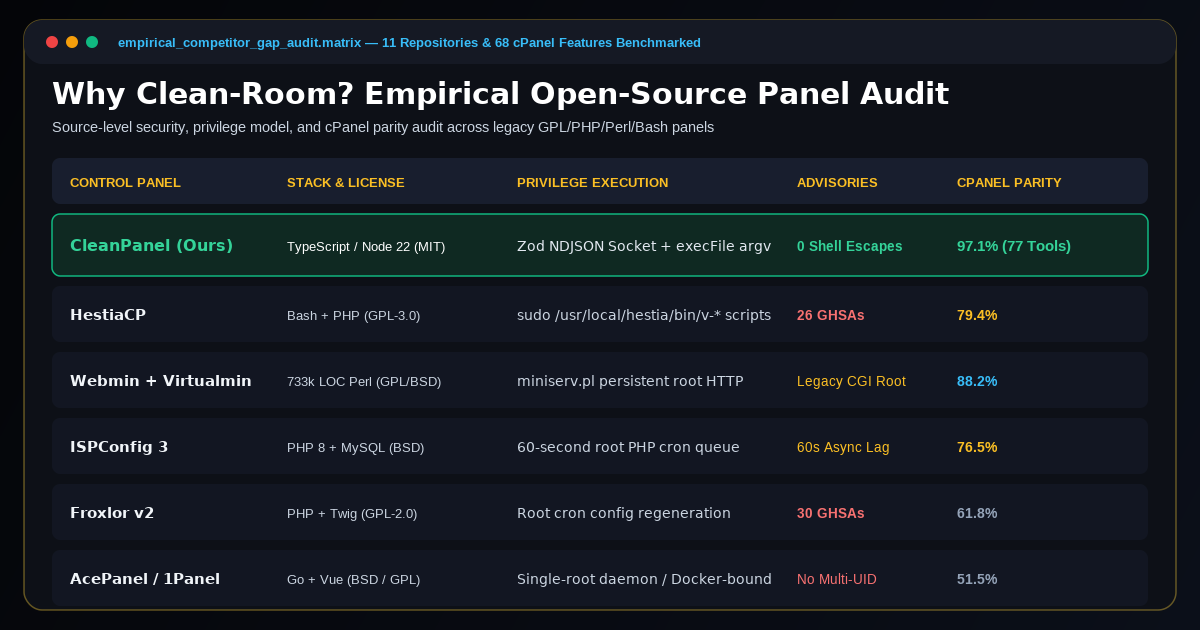
The empirical audit exposed four systemic architectural traps across existing panels:
| Panel | Primary Stack & License | Privileged Execution Mechanism | Key Operational Bottleneck | cPanel Parity |
|---|---|---|---|---|
| CleanPanel (Ours) | TypeScript / Node 22 LTS (MIT) | Unprivileged API + Zod-validated NDJSON Unix socket (execFile argv arrays) |
Zero shell interpolation; dual PANEL_SYSROOT workstation & Linux mode |
97.1% (77 tools) |
| HestiaCP | Bash + PHP (GPL-3.0) | PHP invoking sudo /usr/local/hestia/bin/v-* shell scripts |
26 published GHSAs driven by shell argument concatenation & path quoting | 79.4% |
| Webmin + Virtualmin | ~733k LOC Perl (BSD / GPL) | Persistent root-owned miniserv.pl CGI process tree |
Steep UX friction for cPanel users; legacy Perl maintenance burden | 88.2% |
| ISPConfig 3 | PHP 8 + MySQL (BSD) | Root PHP cron worker polling database every 60 seconds | Up to 60s latency on SSL, vhost, and DNS mutations; dated UI ergonomics | 76.5% |
| Froxlor v2 | PHP + Twig (GPL-2.0) | Scheduled root cron config regeneration | 30 published GHSAs; lacks built-in File Manager, web terminal, and cpmove |
61.8% |
| AcePanel / 1Panel | Go + Vue (BSD / GPL-3.0) | Monolithic root daemon or Docker-coupled app containers | Missing Linux multi-UID tenant isolation, authoritative BIND9, or native mail | 51.5% |
3. CleanPanel Three-Plane Privilege Separation Architecture
CleanPanel eliminates the root-web-server anti-pattern by splitting the appliance into four strictly typed monorepo packages (@cpanel-clean-room/shared, @cpanel-clean-room/server, @cpanel-clean-room/agentd, and @cpanel-clean-room/web) governed by 11 Architecture Decision Records (ADR-01 through ADR-11).
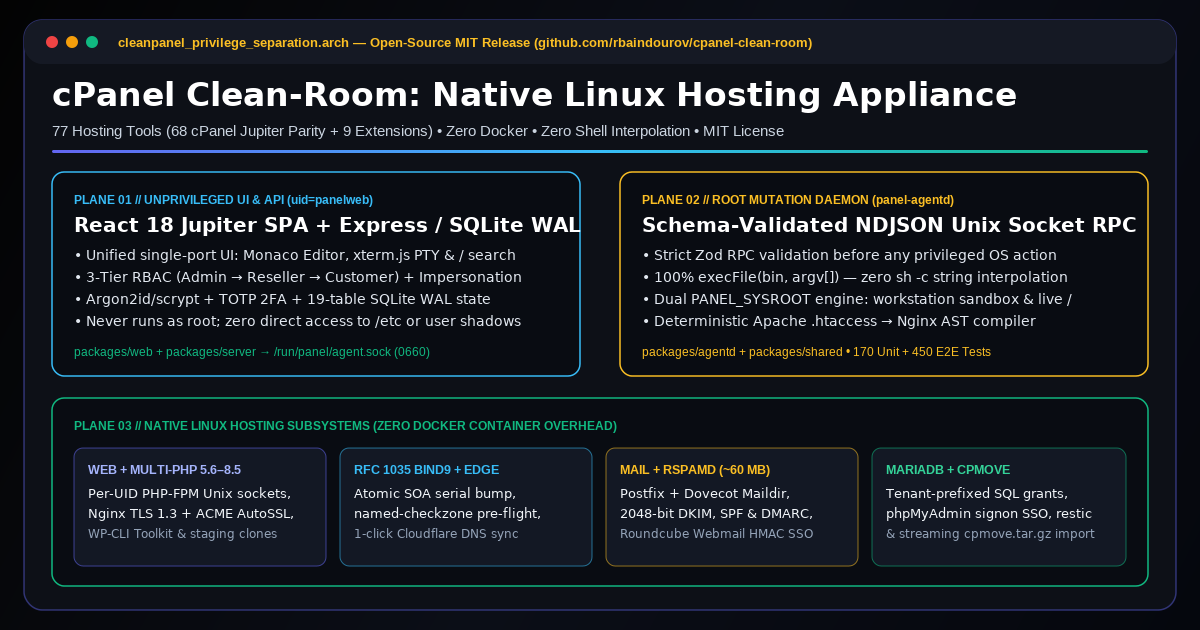
uid=panelweb) from OS configuration mutations via a 0660 NDJSON Unix domain socket guarded by 39 Zod schemas.Plane 1: Unprivileged Control Server & Unified Single-Port SPA
Unlike legacy cPanel—which splits administration across ports 2083, 2087, and 2096—CleanPanel serves the entire Jupiter-modernized React 18 interface, REST API, and authenticated WebSocket PTY multiplexers over a single TLS port running as unprivileged user panelweb. Session state, 3-tier role-based access control (Admin → Reseller → Customer), TOTP 2FA secrets, Argon2id/scrypt credentials, and immutable audit trails live inside a 19-table SQLite database operating in WAL (Write-Ahead Logging) mode.
Plane 2: Schema-Validated Root Daemon (panel-agentd)
Whenever a tenant provisions a domain, rotates a MariaDB grant, edits a file, or triggers an ACME certificate, packages/server dispatches a typed NDJSON request over /run/panel/agent.sock to panel-agentd. Every payload must pass a strict Zod schema in @cpanel-clean-room/shared before execution, and every OS binary call uses Node’s execFile(binary, argvArray)—guaranteeing zero shell string interpolation across all 8 subsystem handlers:
// Every privileged mutation crosses /run/panel/agent.sock as a Zod-validated NDJSON frame
const rpcRequest = AgentRequestSchema.parse({
  id: crypto.randomUUID(),
  action: 'dns.upsertZone',
  actor: { uid: 1042, username: 'acme', role: 'customer' },
  payload: {
    domain: 'example-store.com',
    records: [
      { name: '@', type: 'A', value: '203.0.113.10', ttl: 300 },
      { name: '_dmarc', type: 'TXT', value: 'v=DMARC1; p=quarantine', ttl: 3600 }
    ]
  }
});
// panel-agentd writes atomic temp zone, runs execFile('named-checkzone', [...]), then reloads BIND9
Plane 3: Dual PANEL_SYSROOT Engine & Native Linux Daemons
One of the hardest problems in control-panel engineering is testing privileged configuration generators safely without spinning up slow nested VMs on every commit. CleanPanel solves this via SysrootEngine (ADR-11):
- Workstation Sandbox Mode (
PANEL_SYSROOT=./scratch/sysroot): Generates real Nginx vhosts, per-UID PHP-FPM pool configs (5.6–8.5), RFC 1035 BIND9 zone files with automatic 255-octet TXT chunking, Postfix virtual maps, Dovecot passwd-file hashes, and 2048-bit RSA + Ed25519 DKIM keys inside an isolated local directory tree. - Production Linux Mode (
PANEL_SYSROOT=/): Targets native Ubuntu 22.04/24.04 LTS and Debian 12 paths (/etc/nginx,/etc/php/*/fpm/pool.d,/etc/bind/zones,/etc/postfix,/etc/dovecot,/etc/rspamd) with atomic file replacement, pre-flight syntax checks (nginx -t,named-checkzone,sievec), and systemd service reloads.
4. Solving Real-World cPanel Migration Pain Points
Replacing cPanel on production shared and agency servers requires more than CRUD forms—it requires compatibility with the subtle behaviors existing PHP and WordPress workloads depend upon:
Deterministic .htaccess-to-Nginx Compiler + Hybrid Apache Fallback (ADR-04)
CleanPanel parses standard Apache .htaccess files (RewriteCond, RewriteRule, Redirect, Header, custom ErrorDocument) and compiles them deterministically into native Nginx directives. When a legacy app relies on exotic module rules, toggling use_apache_backend seamlessly proxies that single virtual host to a loopback Apache worker without penalizing modern sites on the box.
- ~60 MB Rspamd Mail Stack vs. ~1.2 GB SpamAssassin/Amavis (
ADR-06): Traditional Perl SpamAssassin + Amavis pipelines routinely consume over a gigabyte of resident RAM even on lightly loaded VPS nodes. CleanPanel pairs Postfix and Dovecot Maildir quotas with C-nativeRspamdfor high-throughput DKIM signing, SPF/DMARC alignment checks, per-user spam thresholds, and HMAC single sign-on into Roundcube Webmail. - Streaming 1-Click
cpmoveArchive Importer (ADR-09): OurCpmoveHandlerstreams standardcpmove-<user>.tar.gzand cPanel full-backup tarballs, automatically normalizing MySQL 8 / MariaDB 10.11 collations (such as translatingutf8mb4_0900_ai_cicleanly on MariaDB hosts), restoring Maildir trees and Dovecot password hashes without forcing password resets, and re-issuing Let’s Encrypt certificates. - 620 Automated Verification Checks: Every release is gated by
170unit tests across all four packages,450four-tier end-to-end API and UI workflow tests, and a 44-check repository leak and artifact integrity verifier (npm run verify).
5. Clone, Run, and Contribute Under the MIT License
The complete monorepo—including all four TypeScript packages, systemd production unit files, the 43-screenshot clean-room reference library, and all 12 architectural & competitor-audit documents—is live now on GitHub under the MIT License:
git clone https://github.com/rbaindourov/cpanel-clean-room.git
cd cpanel-clean-room
npm install

# Run strict TypeScript build, 170 unit tests, and 44-check integrity audit
npm run build && npm test && npm run verify

# Launch CleanPanel locally in safe PANEL_SYSROOT sandbox mode on http://127.0.0.1:3000
npm start
Whether you are migrating WordPress and Multi-PHP workloads off rising per-seat licenses, auditing Linux privilege-separation patterns in TypeScript, or embedding modular hosting primitives into your own infrastructure, launch the live CleanPanel browser sandbox and explore the open-source repository on GitHub.