
Systems Dissection: Google’s Mirror Dimension & User-Space Kernel Isolation for Browser Agents
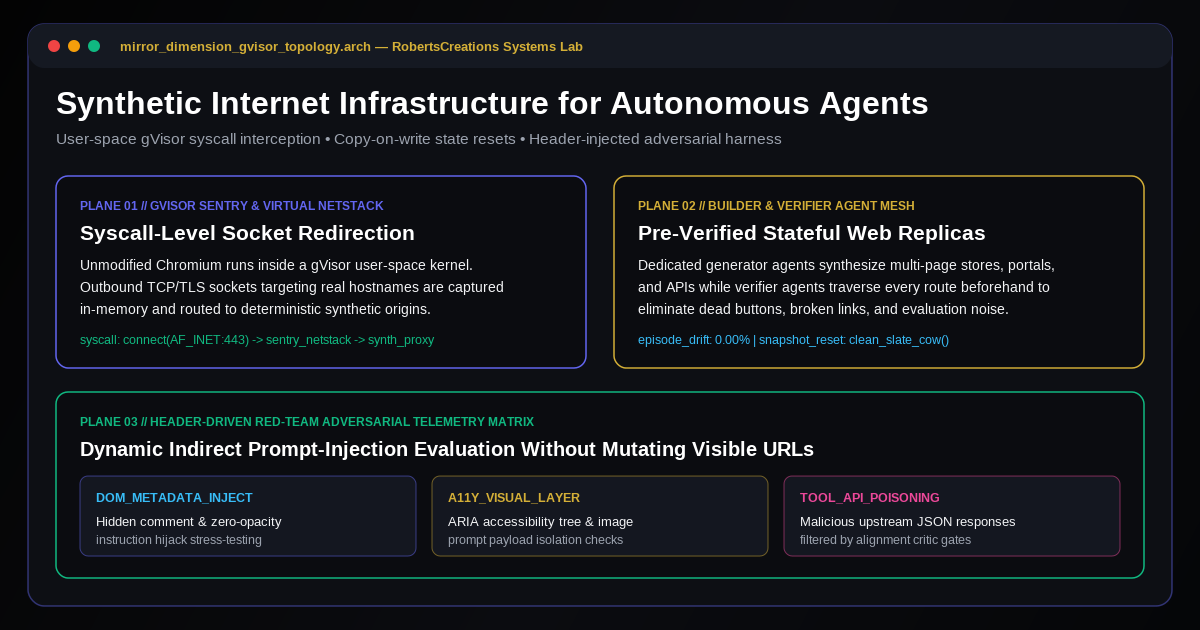
Evaluating autonomous browser agents like Chrome’s Gemini-driven auto-browse requires solving a distributed systems trilemma: zero real-world side effects, bit-exact benchmark reproducibility, and high-throughput adversarial red-teaming. Mirror Dimension achieves all three by pairing gVisor user-space kernel interception with pre-verified stateful synthetic origins and clean-slate snapshot resets.
$ runsc --network=sandbox exec chrome-agent-worker-07
[sentry:syscall] PID 412 -> socket(AF_INET, SOCK_STREAM, IPPROTO_TCP) = fd:19
[sentry:netstack] connect(fd:19, "198.51.100.42:443", SNI="retail-checkout.example")
[sentry:redirect] Host NIC bypassed -> routed to synth-origin-mesh:8443
[egress_guard] External packet count: 0 | Live web mutation risk: 0.00%
gVisor implements a user-space application kernel (Sentry) with its own Go-based TCP/IP stack. Chromium believes it is conversing with external HTTPS origins while every packet stays hermetically sealed inside the synthetic cluster.
Why Standard Linux Containers Were Not Enough
When an autonomous browser agent executes untrusted JavaScript, WebAssembly, and complex multi-step form mutations across thousands of simulated domains, sharing a raw host Linux kernel via standard chroot or basic Docker namespaces leaves too wide a syscall attack surface—and risks accidental packet egress if routing tables misconfigure. By running Chrome inside gVisor (runsc), the user-space Sentry kernel intercepts application syscalls directly and routes network sockets through an isolated virtual netstack straight into the synthetic web cluster.
Comparing Agent Evaluation Isolation Primitives
| Runtime Boundary | Network Containment | Reset Latency | Suitability for Agent RL & Red-Teaming |
|---|---|---|---|
Live Public Web | None — hits real external servers | Impossible (mutates third parties) | Unsafe: triggers real orders, WAF blocks, and benchmark noise. |
Raw OS Namespaces | iptables / veth bridge rules | ~50–150 ms container cycle | Fast, but shares host kernel syscall surface with untrusted pages. |
Full Hardware VM | Virtual NIC hypervisor tap | 500 ms – 3,000 ms snapshot | Strong isolation, but heavier memory footprint at 2,000+ workers. |
Mirror Dimension (gVisor) | User-space Sentry netstack redirect | Sub-millisecond clean-slate state reset | Optimal balance: kernel isolation, realistic URLs, and 0% drift. |
Two-Stage Synthetic Site Integrity & Indirect Prompt-Injection Scaling
A subtle failure mode in synthetic benchmarks is training agents on broken generated websites—where a checkout button lacks an event listener or a form route throws a 500 error. Mirror Dimension eliminates that noise by deploying dedicated development and verification agents ahead of time to build and validate every simulated workflow before any Chrome evaluation worker touches it.
Once functional fidelity is locked, security teams use the same infrastructure as an adversarial range. Hidden instructions are injected across DOM text and metadata, visual imagery and ARIA screen-reader labels, and simulated web-tool API responses—measuring whether alignment critics and delimiter spotlighting keep the browser agent anchored to the user’s authorized objective across thousands of automated trials.